
Landscape Lighting Ideas for Toronto Backyards
A beautiful backyard can look completely different after sunset. The right landscape lighting can turn a dark patio into an inviting entertaining area, make pathways easier to navigate, highlight mature trees and architectural features, and give a thoughtfully designed Toronto property another dimension at night.
The challenge is knowing where to place fixtures, how much illumination is enough, and which lighting techniques actually improve the space rather than simply making it brighter.
For homeowners considering a backyard upgrade, landscape lighting should be treated as part of the overall landscape design process not as a collection of lights added at the end. A successful plan considers how you use the property, what you want people to notice, where safety matters, and how the system will perform through Toronto’s changing seasons with proper landscape engineering considerations.
This guide explores practical outdoor lighting ideas, from pathways and patios to trees, water features, entertaining areas, and luxury landscaping applications.
Landscape lighting is a planned outdoor lighting system that improves visibility, highlights landscaping and architecture, and makes a backyard more enjoyable after dark. Effective designs combine pathway, accent, ambient, and architectural lighting while controlling glare and avoiding excessive brightness.
Why Landscape Lighting Can Transform a Backyard
The biggest mistake homeowners make is thinking outdoor lighting is primarily about visibility.
It is also about composition.
During daylight, trees, planting beds, retaining walls, patios, decks, and architectural details naturally create depth. At night, those elements can disappear into darkness unless carefully illuminated.
Well-designed landscape lighting restores that depth by deciding what should be visible, what should remain subtle, and where the eye should move.
A thoughtful design can help you:
- Make walkways, steps, and transitions easier to navigate
- Extend the usable hours of patios, outdoor kitchens, and your outdoor living space
- Highlight mature trees and garden features
- Create a more welcoming arrival experience
- Add visual depth to a small backyard
- Complement luxury landscaping and architectural design
- Improve visibility around selected areas of the property
- Create different moods for entertaining and relaxing
The goal isn’t to illuminate every square metre. In fact, contemporary outdoor design increasingly relies on contrast between illuminated and darker areas. Toronto-focused lighting specialists similarly emphasize selective illumination, layered design, and avoiding excessive brightness.
Use Pathway Lighting to Guide Movement
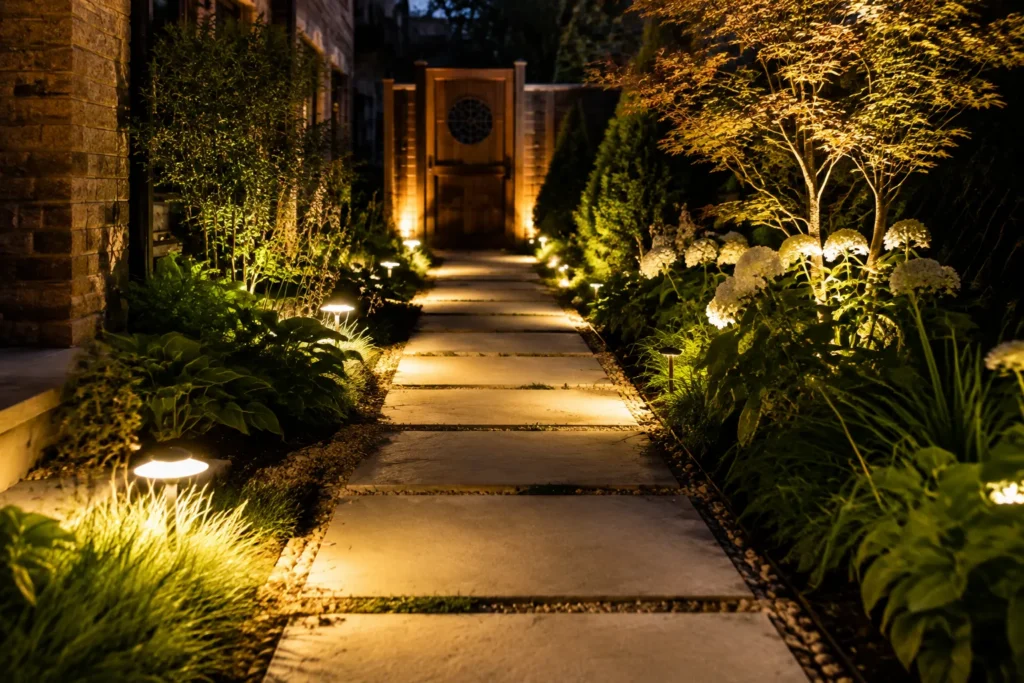
Pathway illumination is one of the most practical forms of landscape lighting.
Instead of installing bright fixtures that create a runway effect, use low-level lights to define the route. The lighting should help visitors understand where to walk without becoming the main visual feature.
Consider it for:
- Garden paths
- Steps and stairways
- Walks between the house and patio
- Side-yard passages
- Driveway approaches
- Changes in elevation
A better approach to pathway lighting
Avoid placing identical fixtures in a perfectly straight line unless the architecture specifically calls for it.
Staggering fixtures can produce a more natural appearance and reduce the feeling that the path is lined with runway lights. Fixtures should generally direct light downward and away from people’s eyes.
For Toronto properties, also consider snow accumulation, seasonal planting growth, and the position of maintenance equipment before finalizing fixture locations.
Highlight Trees With Uplighting
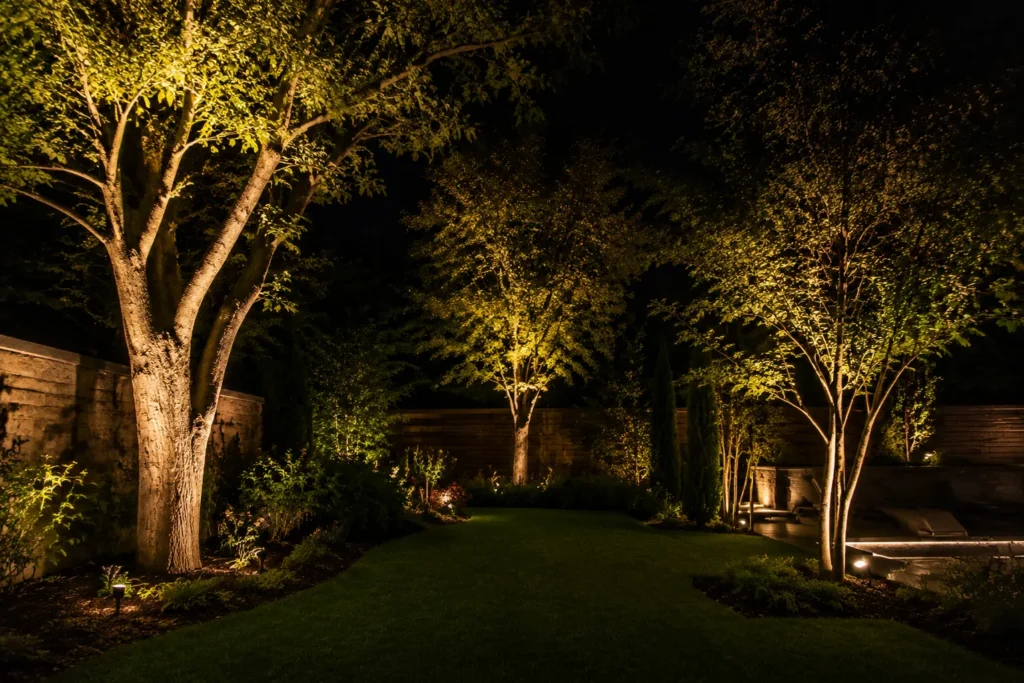
Trees are among the most rewarding subjects for landscape lighting because their shape changes dramatically at night.
A carefully positioned spotlight can illuminate the trunk and lower canopy. With larger trees, multiple fixtures can create a layered effect that reveals branches and foliage at different heights.
This works particularly well with:
- Mature maples
- Evergreens
- Ornamental trees
- Multi-stem trees
- Specimen trees near patios
Try moonlighting for a softer effect
Moonlighting involves positioning a fixture higher in a tree and directing light downward so shadows fall naturally across the ground.
The result can feel more subtle than a bright spotlight pointed directly at the tree.
The important principle is restraint. You don’t necessarily need to light the entire canopy. Highlighting selected branches can create more depth while preserving darker areas.
Make the Patio the Backyard’s Nighttime Focal Point
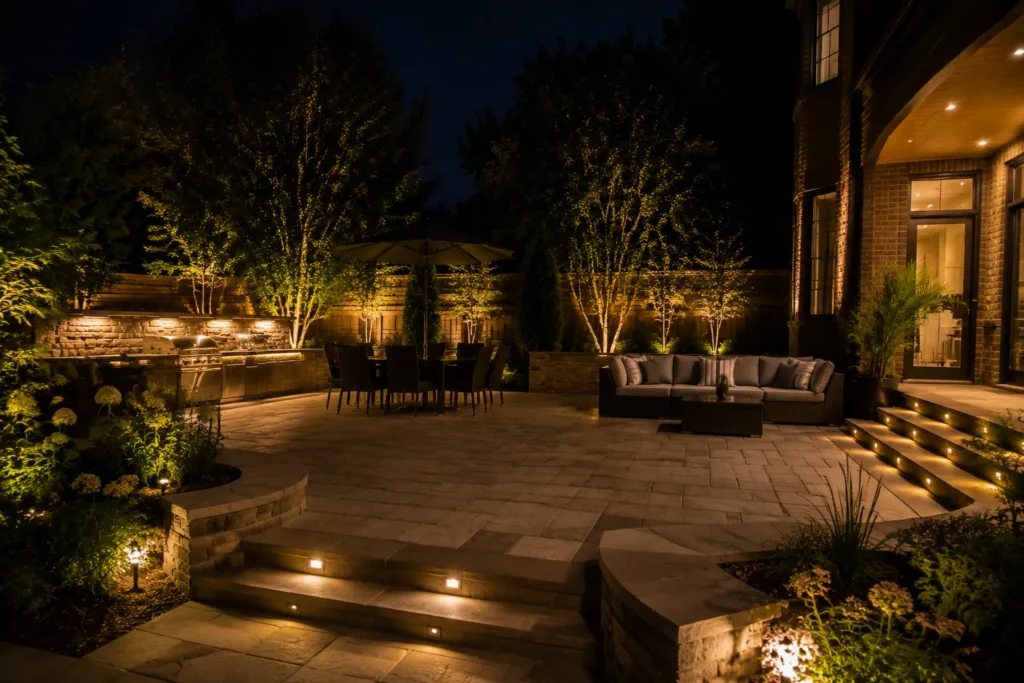
If your family spends most evenings on the patio, that’s where your landscape lighting budget should earn its keep.
Think beyond a single overhead fixture.
A comfortable patio often benefits from several layers:
- Ambient lighting for general illumination
- Task lighting around cooking or preparation areas
- Accent lighting for plants, walls, artwork, or architectural details
- Step lighting where elevation changes exist
This layered approach prevents the patio from feeling either too dark or aggressively bright.
For a luxury landscaping project, concealed fixtures can be especially effective because the light becomes visible while the hardware remains visually quiet.
Add Deck and Stair Lighting
Deck stairs are both functional and architectural opportunities.
Small recessed or surface-mounted fixtures can define stair edges without overwhelming the deck. Rail lighting can provide a soft glow, while carefully positioned downlights can illuminate circulation areas.
The best landscape lighting for stairs should make the change in elevation obvious without producing harsh glare.
Before installation, consider:
- Stair geometry
- Handrail position
- Fixture visibility
- Water drainage
- Snow and ice
- Maintenance access
- How the lights appear from inside the house
That last point matters more than many homeowners realize. Your backyard is often viewed through windows and doors at night, so the lighting should look good from indoors as well as outside.
Create a Luxury Look With Layered Lighting
Luxury landscaping isn’t necessarily about installing more fixtures.
It is about controlling what the viewer sees.
A premium-looking outdoor space typically combines several lighting techniques rather than relying on one fixture type.
For example:
Path → subtle wayfinding
Tree → vertical focal point
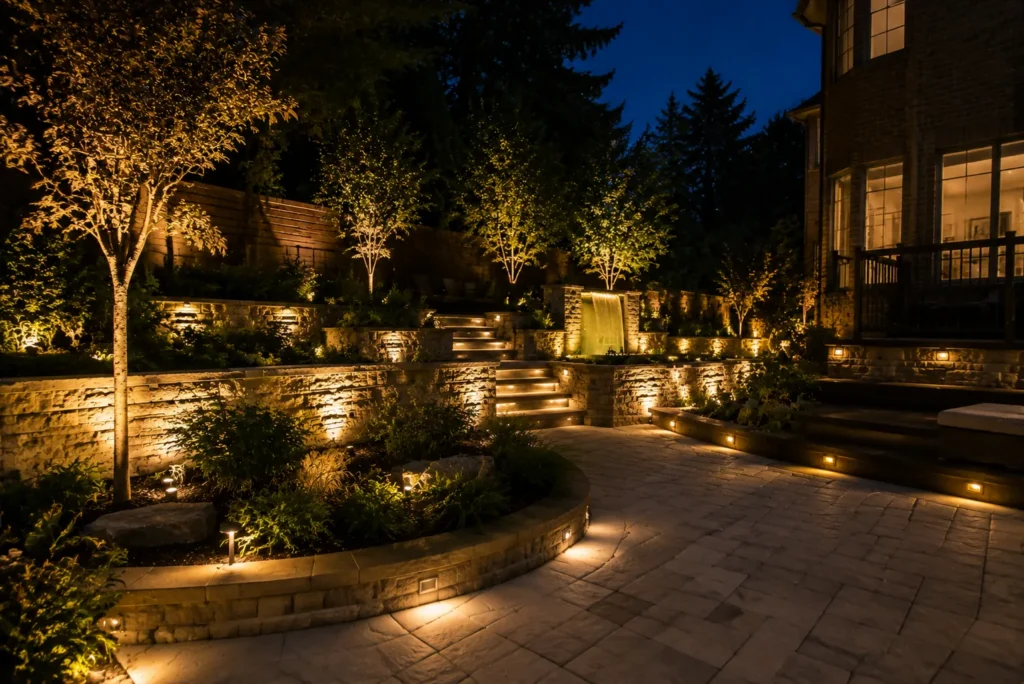
Retaining wall → texture and depth
Patio → comfortable ambient illumination
Steps → functional safety
Architectural feature → visual emphasis
This hierarchy gives the backyard a deliberate nighttime composition.
One of the strongest principles in modern landscape lighting is to illuminate the subject rather than the fixture. When people notice the fixture before they notice the tree, wall, planting, or architecture, the design often needs refinement.
Use Wall Grazing to Reveal Texture
Have a stone retaining wall, brick feature, textured concrete surface, or architectural wall?
Try grazing.
Wall grazing places light close enough to a surface that shadows reveal its texture. Rough stone can become dramatically more interesting after dark because every irregularity produces subtle shadow.
This is particularly effective in luxury landscaping where natural stone, masonry, and custom-built architectural elements are major visual investments.
However, grazing is highly dependent on fixture position. Move the light too far away and the texture becomes less pronounced. Place it too close and the effect can become overly dramatic.
Illuminate Garden Beds Without Flattening Them
A common landscape lighting mistake is lighting planting beds uniformly.
Uniform brightness removes depth.
Instead, identify three levels:
- Foreground: low plants, edging, or ornamental grasses
- Middle: shrubs and planting masses
- Background: trees, fences, walls, or structures
Then use different lighting intensities and techniques to create visual layers.
For example, a softly illuminated ornamental grass in front of a darker shrub mass can look more sophisticated than illuminating everything equally.
This approach also allows seasonal planting changes to remain part of the design rather than forcing every plant to receive permanent illumination.
Turn a Water Feature Into a Nighttime Focal Point
Pools, fountains, ponds, and waterfalls can become striking focal points when illuminated carefully.
Water reflects light, so excessive brightness can quickly create glare.
Instead, consider illuminating:
- Water movement
- Surrounding planting
- A nearby architectural wall
- Pool steps
- The edge of a feature
For pools and spas, electrical safety becomes especially important. Ontario’s Electrical Safety Code applies to electrical work, while the Electrical Safety Authority (ESA) provides specific guidance for outdoor and pool-related electrical installations.
If your project involves electrical modifications, pool equipment, or new circuits, involve the appropriate licensed electrical professional rather than treating the project as a simple decorative installation.
Choose Warm Light for Outdoor Living Areas
Colour temperature has a major effect on how a backyard feels.
For patios, gardens, seating areas, and residential landscapes, warmer light is often more comfortable and visually compatible with natural materials.
A practical starting point is approximately 2700K–3000K for many residential applications, although the right choice depends on the materials, architecture, planting, and desired atmosphere.
Warm lighting can complement:
- Natural stone
- Wood decking
- Brick
- Green foliage
- Outdoor furniture
- Warm architectural finishes
The goal is consistency. Mixing dramatically different colour temperatures without a design reason can make a backyard feel visually disconnected.
Combine Landscape Lighting With Security Lighting
Security and aesthetic lighting serve different purposes.
Bright motion-activated floodlights can provide useful visibility around vulnerable areas, but they aren’t always appropriate for creating a relaxing backyard atmosphere.
Instead, use landscape lighting for general wayfinding and visual definition, while reserving stronger security lighting for locations where it is actually needed.
Potential areas include:
- Side entrances
- Garage approaches
- Gates
- Dark corners
- Service areas
- Driveway edges
This creates a better balance between security, comfort, and aesthetics.
Don’t over-light for security
A backyard that is uniformly bright isn’t necessarily better designed or more secure.
Glare can actually make it harder to see beyond the illuminated area. Strategic illumination combined with appropriate controls can provide a more comfortable result.
Design the Lighting Around Toronto’s Climate
Toronto homeowners need to think beyond the first night after installation.
Outdoor systems experience:
- Snow
- Freeze-thaw cycles
- Rain
- Soil movement
- Seasonal plant growth
- Lawn and garden maintenance
- Salt and winter conditions
That makes fixture quality, installation technique, cable routing, drainage, and maintenance important parts of the project.
The Electrical Safety Authority specifically notes that outdoor low-voltage lighting systems require appropriate transformers and that underground wiring must be installed according to applicable requirements. ESA also recommends contacting Ontario One Call before digging to locate underground infrastructure.
In other words, beautiful landscape lighting should also be designed for the environment in which it will operate.
Low-Voltage vs. Line-Voltage Lighting
One of the most important decisions is choosing the appropriate electrical approach.
Low-voltage systems
Low-voltage systems are commonly used for residential pathway, accent, garden, and architectural applications. A transformer reduces household electrical power to a lower voltage for the lighting circuit.
Advantages can include:
- Flexible fixture placement
- Good suitability for garden applications
- Efficient LED operation
- Easier integration with many landscape designs
Line-voltage systems
Line-voltage lighting can make sense for certain permanent architectural, structural, or high-output applications.
However, it involves different electrical considerations and should not be approached casually.
Ontario’s Electrical Safety Code governs electrical installations in the province, and ESA emphasizes using qualified electrical professionals for electrical work.
The right choice depends on the property’s design, electrical infrastructure, fixture requirements, and installation conditions not simply which option is cheaper.
Plan the System Before Installing the Fixtures
Good landscape lighting starts with observation rather than shopping.
Before purchasing anything, walk through the property after dark.
Stand at:
- The kitchen window
- Living-room doors
- Main entrance
- Patio seating area
- Garden path
- Driveway
- Side yard
Ask three questions:
What should I see?
Identify trees, architecture, paths, and entertaining areas worth highlighting.
Where do I need visibility?
Identify steps, changes in elevation, entrances, and circulation routes.
Where should darkness remain?
Not every corner needs illumination.
This simple exercise often produces a better lighting plan than starting with a catalogue of fixtures.
A Practical Backyard Lighting Formula
For a typical Toronto backyard, start with four layers:
Layer 1: Movement
Illuminate paths, steps, entrances, and transitions.
Layer 2: Architecture
Highlight walls, pergolas, fences, retaining structures, and other built elements.
Layer 3: Landscape
Use uplighting, downlighting, grazing, and selective accent lighting for trees and planting.
Layer 4: Living
Create comfortable illumination around patios, decks, outdoor kitchens, dining areas, and seating zones.
This framework keeps the design balanced.
If you are planning a broader backyard renovation, consider integrating the lighting plan with the hardscape, planting, grading, drainage, and professional landscape construction from the beginning.That is where landscape lighting can become part of a cohesive luxury landscaping concept rather than an afterthought.
A Quick Design Checklist
Before finalizing your plan, ask:
- Are pathways and steps easy to understand after dark?
- Are the main trees or landscape features appropriately highlighted?
- Is the patio comfortable rather than excessively bright?
- Are fixtures hidden where possible?
- Is glare controlled from seating areas and windows?
- Are colour temperatures reasonably consistent?
- Does the design work with the home’s architecture?
- Can the system accommodate future landscape changes?
- Are electrical installations compliant with applicable Ontario requirements?
- Has underground infrastructure been located before digging?
Common Landscape Lighting Mistakes to Avoid
1. Using too many fixtures
More fixtures don’t automatically create a better result.
Start with the features that matter most and build outward.
2. Choosing excessive brightness
Overly bright lighting can create glare and flatten the landscape.
3. Ignoring fixture visibility
A beautiful tree can lose impact if an obvious fixture becomes the first thing people notice.
4. Lighting everything equally
Contrast creates depth. Leave some areas intentionally darker.
5. Designing only for summer
Toronto’s landscape changes significantly through the year. Snow, plant growth, and seasonal maintenance should influence fixture placement.
6. Treating electrical work as purely decorative
Outdoor electrical systems need to meet applicable safety requirements. ESA and Ontario’s Electrical Safety Code should be consulted for projects involving electrical installations or modifications.
When Should You Hire a Professional?
DIY solar lights can work for simple decorative applications, but a larger landscape lighting project benefits from professional planning when it involves multiple zones, permanent wiring, architectural integration, mature trees, complex grading, pools, or significant electrical work.
Professional planning is especially valuable when the lighting needs to coordinate with a larger landscape renovation.
A good designer should think about the property as a whole:
Architecture + hardscape + planting + circulation + lighting + maintenance
That integrated approach is particularly important for homeowners investing in luxury landscaping, because the lighting should enhance the quality of the landscape rather than compete with it.
If you’re planning a Toronto backyard transformation, explore Everstruct’s website to see how a broader landscape design approach can support the outdoor space you want to create.
Frequently Asked Questions
What is the best type of landscape lighting for a backyard?
There isn’t one universal fixture type. Most successful residential designs combine pathway lights, spotlights, downlights, accent fixtures, and architectural lighting according to how each area is used.
Is warm or cool lighting better for landscaping?
Warm light is often a comfortable starting point for residential gardens, patios, and entertaining spaces. Around 2700K–3000K is commonly used, but the best temperature depends on the architecture, materials, plants, and desired atmosphere.
How do I make outdoor lighting look expensive?
Focus on restraint rather than quantity. Hide fixtures where practical, use layered illumination, highlight architectural and landscape features, control glare, and create contrast between illuminated and darker areas.
Is low-voltage lighting safer for a backyard?
Low-voltage systems reduce the voltage used by the landscape lighting circuit, but the overall installation still needs to be designed and installed appropriately. Electrical work in Ontario must comply with the applicable Electrical Safety Code.
Should landscape lighting stay on all night?
Not necessarily. Timers, photocells, smart controls, and zoning can allow homeowners to adjust operating schedules according to how the property is used. Reducing unnecessary nighttime illumination can also preserve darker areas.
Can landscape lighting be added after landscaping is finished?
Yes, but installing lighting during a landscape renovation can make planning cable routes, fixture locations, drainage, planting, and hardscape integration considerably easier. Retrofitting an established landscape may require more careful excavation and coordination.
Final Thoughts
The best landscape lighting doesn’t make a backyard look like a parking lot.
It makes the right things visible.
A softly illuminated path can make a garden feel more inviting. A mature tree can become a dramatic focal point. Subtle deck lighting can make dinner outdoors more comfortable. Carefully controlled architectural illumination can reveal materials and textures that disappear after sunset.
For Toronto homeowners, the strongest results come from combining aesthetics with practical considerations such as weather exposure, maintenance, electrical safety, and the way the property is actually used.
If you’re planning a backyard renovation or luxury landscaping project, think about the nighttime experience before the construction begins. With the right strategy, landscape lighting can connect the architecture, planting, hardscape, and outdoor living areas into one cohesive environment and make your backyard feel like an extension of your home long after the sun goes down.
For a more comprehensive outdoor transformation, visit Everstruct and consider how professional landscape planning can bring your vision together.