
Backyard Water Features – Ideas, Types, Costs & Design Guide for Toronto Homes
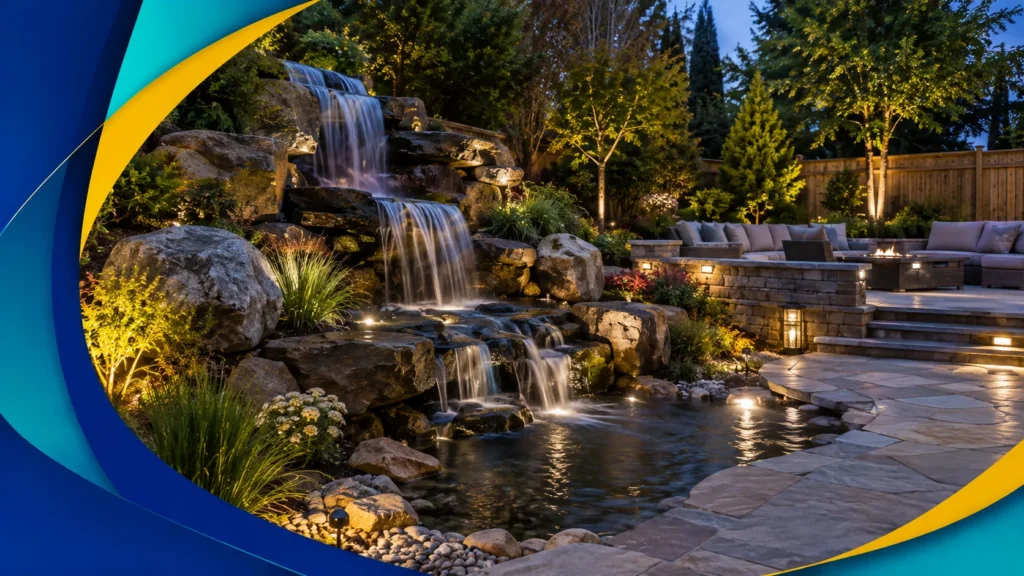
A well-designed water feature can completely change the character of a backyard. The sound of moving water can make a patio feel more relaxing, a waterfall can become a natural focal point, and even a compact fountain can give an otherwise ordinary garden more visual interest.
But choosing a backyard water feature is about more than picking something that looks attractive in a photograph.
The right design depends on the size and shape of your yard, how you use the space, your preferred style, maintenance expectations, available utilities, drainage, safety considerations, budget, and especially in Toronto the way the installation will perform through Canadian winters.
From pondless waterfalls and natural rock cascades to modern water walls, garden ponds, fountains and compact bubbling rocks, there are more options than ever.
This guide explains the most popular backyard water features, how they compare, what they can cost, how to choose the right option, and what Toronto homeowners should consider before installation.
What Are the Best Backyard Water Features?
The best backyard water feature depends on what you want the feature to accomplish.
A pondless waterfall is an excellent choice when you want the sound and movement of a waterfall without a large exposed pond.
A garden pond works well if you want aquatic plants, fish or a more natural ecosystem.
A fountain is often the simplest choice for compact yards, patios and formal landscapes.
A bubbling rock can create a natural-looking focal point without requiring a large footprint.
A water wall suits contemporary homes and modern outdoor living spaces.
A stream or landscape waterfall can make sense when the property has enough space or natural grade to create movement through the landscape.
The important point is that there is no single “best” water feature. The best choice is the one that fits your property and the way you actually intend to use your backyard.
What Is a Backyard Water Feature?
A backyard water feature is a designed landscape element that introduces water into an outdoor space for visual interest, sound, recreation, ecological value or a combination of these purposes.
Some features use continuously recirculating water. A pump moves water from a pond, basin or hidden reservoir to the top of the feature, where gravity brings it back down.
Others are primarily decorative, such as birdbaths or small container water gardens.
Backyard water features can range from a small bubbling fountain beside a patio to a large naturalistic waterfall with multiple cascades, stonework, planting and a pond.
The design should always be considered as part of the landscape rather than as an isolated object.
A waterfall beside a patio, for example, can become much more effective when its stonework, planting, lighting, seating and surrounding hardscape are designed together.
15 Backyard Water Feature Ideas
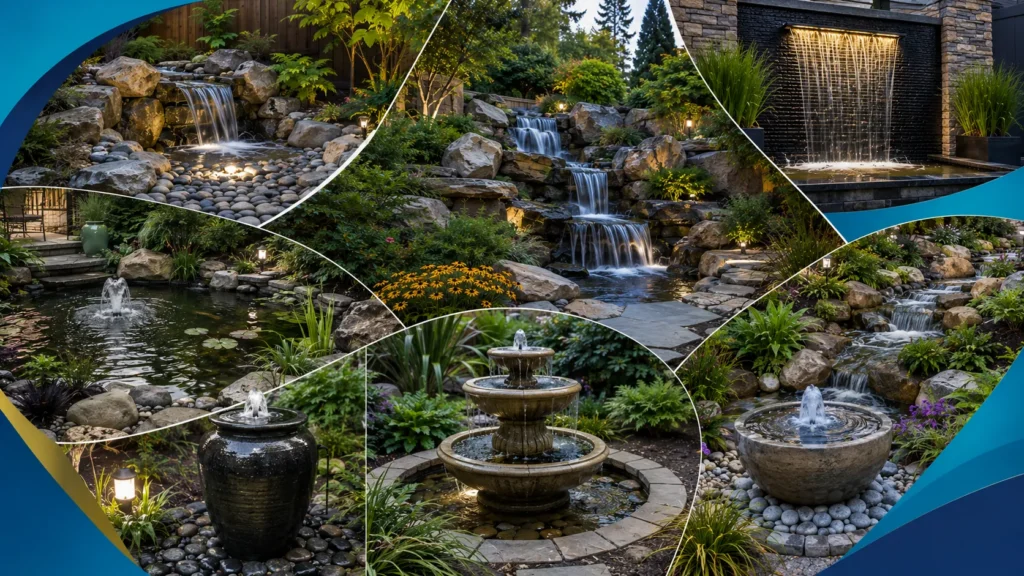
1. Pondless Waterfall
A pondless waterfall creates the appearance and sound of a waterfall without an exposed pond at its base.
Water flows over stone or another designed surface and disappears into a gravel-covered or otherwise concealed collection area. A hidden reservoir stores the water before a pump sends it back to the top.
This is one of the most versatile choices for residential landscapes.
Best for:
- Homeowners who want waterfall sound
- Smaller or medium-sized backyards
- Families concerned about exposed standing water
- Low-profile landscape designs
- Patios and outdoor seating areas
Advantages
- No large visible pond
- Strong visual movement
- Can be customized to many landscapes
- Can work in relatively compact areas
- Provides the sound of moving water
Aquascape also identifies pondless waterfalls as a low-maintenance landscape water-feature option that can be customized for different spaces.
2. Natural Rock Waterfall
A natural rock waterfall uses carefully positioned boulders, ledge stone and smaller rock to create a more organic cascade.
Rather than looking like a manufactured fountain, the goal is to make the water appear as though it naturally belongs to the landscape.
Natural waterfalls can be particularly effective when surrounded by planting, ornamental grasses and other natural materials.
Best for:
- Naturalistic gardens
- Large backyards
- Cottage-inspired landscapes
- Properties with existing slopes
- Homeowners who want a strong focal point
The success of a natural waterfall depends heavily on stone placement. Simply stacking rocks and allowing water to run over them rarely produces the same controlled appearance as a carefully designed cascade.
3. Garden Pond
A garden pond introduces a body of water into the landscape and can become an ecosystem-like focal point.
Depending on its design, a pond may include:
- Aquatic plants
- Rocks
- Waterfalls
- Fish
- Sheltered edges
- Shallow planting zones
- Circulation and filtration
A pond creates a fundamentally different experience from a fountain because the water itself becomes a major part of the landscape.
Best for:
- Larger gardens
- Nature-focused landscapes
- Homeowners interested in aquatic plants
- Fish enthusiasts
- Wildlife-oriented gardens
The trade-off is that ponds generally require more planning and maintenance than a simple recirculating fountain.
4. Koi Pond
A koi pond is designed specifically around keeping koi fish.
That makes it more than a decorative water feature.
The depth, filtration, circulation, water quality and habitat need to be appropriate for the fish.
Aquascape describes koi ponds and water gardens as a distinct backyard category that can combine aquatic plants, fish and an ecosystem-oriented approach.
Choose a koi pond if:
You genuinely want the experience of maintaining and enjoying fish.
Don’t choose one simply because koi ponds look beautiful in photographs. A living aquatic system creates ongoing responsibilities that should be considered before construction.
5. Bubbling Rock
A bubbling rock is a natural stone or sculptural element through which water rises or bubbles before flowing back into a concealed collection area.
It can create the impression of a small natural spring without requiring a large waterfall.
Best for:
- Small yards
- Courtyards
- Patio edges
- Modern-natural landscapes
- Homeowners who want minimal visual complexity
Several smaller bubbling rocks can also be grouped together to create a stronger focal point.
6. Urn or Vessel Fountain
An urn fountain uses a decorative vessel as the primary visual element.
Water may bubble from the top, spill over the edge or circulate between multiple vessels.
This is an excellent way to introduce water into a formal or contemporary landscape without building a large pond.
Materials can include:
- Stone
- Concrete
- Ceramic
- Metal
- Composite materials
The vessel should complement the architecture and hardscape around it rather than looking like an unrelated decoration.
7. Wall Water Feature
A wall water feature sends water down or across a vertical surface.
It can be particularly useful when horizontal space is limited.
For example, a narrow backyard may have enough room for a feature against a privacy wall even when a pond or large waterfall would be impractical.
Best for:
- Modern homes
- Narrow backyards
- Courtyards
- Patio areas
- Architectural landscapes
Water walls can also combine especially well with landscape lighting because the moving water becomes a reflective surface after dark.
8. Tiered Fountain
Tiered fountains create multiple levels of falling water.
They tend to work particularly well in formal, traditional or European-inspired landscapes.
The number and height of the tiers affect both appearance and sound.
A compact tiered fountain can be appropriate for a small garden, while larger architectural fountains can become major focal points.
9. Garden Stream
A stream can create movement through the backyard instead of concentrating the water feature in one location.
The water can travel around planting beds, beneath a small bridge or toward a pond or hidden reservoir.
A stream works particularly well when the landscape has enough length or natural grade to make the journey of the water visually meaningful.
Consider a stream when:
- Your property has a natural slope
- You want a more immersive landscape
- You have enough room for meandering movement
- You want to connect multiple landscape zones
10. Water Garden
A water garden combines shallow water with aquatic plants.
It can be relatively compact and doesn’t necessarily require the scale of a traditional pond.
Water gardens can work in containers, raised vessels or purpose-built shallow basins.
They are particularly attractive for homeowners who want the visual character of water combined with planting.
11. Wildlife Pond
A wildlife pond is designed around supporting local wildlife rather than simply creating an ornamental focal point.
Birds, insects, amphibians and other wildlife may use suitable water environments.
If ecological value is important to you, consider the surrounding planting as carefully as the water itself.
Native and climate-appropriate plants can help create a more integrated landscape.
12. Birdbath
A birdbath is among the simplest water features.
It requires little space and can be added to an established garden without major construction.
Although it doesn’t create the dramatic sound of a waterfall, it can introduce water and wildlife into a small backyard.
13. Modern Water Wall
A contemporary water wall can combine architectural materials with moving water.
Possible materials include:
- Stone
- Concrete
- Porcelain
- Metal
- Glass
- Custom masonry
This approach is especially appropriate when the water feature needs to relate closely to a modern home’s architecture.
14. Fire-and-Water Feature
Fire and water create a dramatic visual contrast.
A feature may combine a bowl, water circulation and a flame element into one architectural focal point.
These installations can work particularly well around:
- Outdoor kitchens
- Covered patios
- Pool areas
- Lounge spaces
- Luxury backyard entertaining areas
Because gas and electrical components may be involved, these installations should receive appropriate professional planning.
15. Pool Waterfall or Spillway
If you already have a swimming pool, the water feature doesn’t necessarily need to be separate from it.
Options can include:
- Rock waterfalls
- Sheer descents
- Spillways
- Decorative scuppers
- Architectural water walls
The goal is to make the water feature feel like part of the pool and surrounding landscape rather than an accessory added afterward.
Backyard Water Features Compared
| Water Feature | Best For | Space Required | Sound | Maintenance | Typical Complexity |
| Pondless waterfall | Sound and movement | Small–Medium | Medium–High | Low–Moderate | Moderate |
| Natural waterfall | Dramatic landscape | Medium–Large | High | Moderate | High |
| Garden pond | Plants and nature | Medium–Large | Low–Medium | Moderate–High | High |
| Koi pond | Fish keeping | Medium–Large | Low–Medium | High | High |
| Bubbling rock | Small focal point | Small | Low–Medium | Low | Low–Moderate |
| Urn fountain | Patio/garden design | Small | Low–Medium | Low | Low |
| Wall fountain | Compact spaces | Small | Low–Medium | Low | Low–Moderate |
| Tiered fountain | Formal landscapes | Small–Medium | Medium | Low–Moderate | Moderate |
| Stream | Natural movement | Medium–Large | Medium–High | Moderate | High |
| Water garden | Aquatic planting | Small–Medium | Low | Moderate | Moderate |
| Wildlife pond | Ecology | Medium–Large | Low | Moderate | High |
| Birdbath | Small gardens | Very Small | Very Low | Low | Very Low |
| Water wall | Modern design | Small–Medium | Medium | Moderate | Moderate–High |
| Fire + water | Luxury entertaining | Medium | Medium | Moderate | High |
| Pool waterfall | Pool landscapes | Medium–Large | Medium–High | Moderate | High |
These aren’t rigid categories. A custom water feature can combine several approaches for example, a pondless waterfall can include a short stream, architectural wall, lighting and integrated planting.
Landscape Waterfalls: Why They Make Such a Strong Backyard Feature
Among all backyard water features, landscape waterfalls are particularly effective because they combine three things:
Movement, sound and structure.
A pond mainly gives you reflection and habitat.
A fountain can provide movement and sound.
A waterfall can introduce vertical movement, sound, texture and a strong sense of direction.
That makes waterfalls especially useful as focal points.
They can also help organize a backyard.
For example:
House → patio → seating → waterfall → planting
The waterfall can become the destination at the end of a visual axis.
On a sloped Toronto property, the grade can sometimes be incorporated into the design to create natural-looking cascades rather than fighting the existing topography.
Pond vs Pondless Waterfall vs Fountain: Which Is Better?
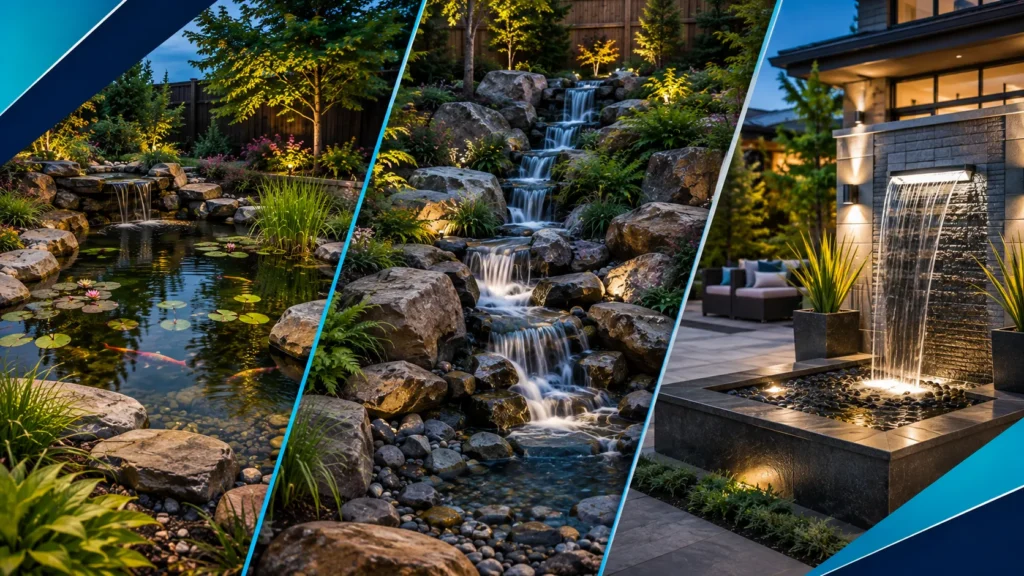
There is no universal winner.
Choose a pond if:
You want:
- Aquatic plants
- Fish
- Wildlife
- A larger ecosystem
- Reflection
- A natural garden focal point
Choose a pondless waterfall if:
You want:
- Waterfall sound
- Movement
- A strong focal point
- Less exposed standing water
- A more compact design
Choose a fountain if:
You want:
- Simplicity
- A smaller footprint
- A decorative focal point
- Easier installation
- Formal or architectural styling
If you’re unsure, think about the experience you want rather than the feature name.
Ask:
Do I want to watch water, hear water, interact with aquatic life, or simply add a focal point?
The answer usually makes the choice much easier.
Best Backyard Water Features for Small Yards
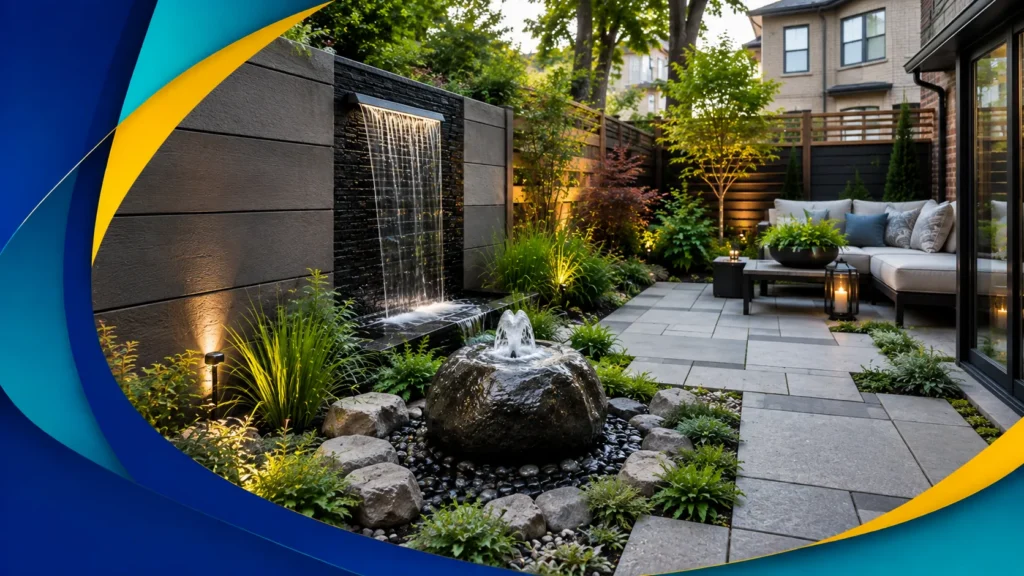
Small backyards don’t automatically mean you have to give up on water.
In fact, smaller features can sometimes have a greater visual impact because they don’t compete with as many landscape elements.
Good options include:
Bubbling rocks
Compact and natural-looking.
Wall fountains
Use vertical space instead of consuming much floor area.
Small urn fountains
Easy to integrate beside planting or seating.
Mini ponds
Useful for patios and compact gardens.
Small pondless waterfalls
Can provide the sound of moving water without requiring a full pond.
For a small Toronto backyard, proportion is critical.
A feature that is too large can make the entire yard feel smaller.
Best Water Features for Large Backyards
Larger properties create opportunities for more ambitious designs.
Consider:
- Multi-level waterfalls
- Meandering streams
- Large ponds
- Koi ponds
- Natural rock cascades
- Integrated pool waterfalls
- Large architectural water walls
- Fire-and-water features
Large features should still have a purpose.
More water doesn’t automatically mean a better landscape.
The strongest designs usually establish a clear focal point and then use planting, paths, patios and structures to support it.
Best Water Features for Families With Children or Pets
Safety should be considered before aesthetics.
An exposed pond introduces standing water and therefore requires a different safety approach from a pondless design.
A pondless waterfall can be an attractive alternative when the homeowner wants the visual and auditory qualities of a waterfall without making a large open pond the centre of the yard.
However, “pondless” does not mean “automatically risk-free.”
Every project should consider:
- Water depth
- Access
- Slippery surfaces
- Electrical equipment
- Pump protection
- Nearby steps
- Surrounding hardscape
- Supervision requirements
Water-feature safety should be evaluated as part of the entire landscape design.
How Much Do Backyard Water Features Cost in Toronto?
There is no single reliable price for a backyard water feature because the cost can vary dramatically with the design.
The biggest cost factors include:
1. Size
A small fountain and a multi-level waterfall are fundamentally different construction projects.
2. Excavation
Ponds, streams and large reservoirs require more excavation and site preparation.
3. Stone
Natural boulders, premium stone and custom masonry can significantly affect the budget.
4. Pump and circulation equipment
Pump capacity, plumbing requirements and system configuration influence both installation and operating costs.
5. Electrical work
Lighting, pumps and controls may require electrical planning and installation.
6. Drainage and grading
Water needs to go somewhere when the system is shut down, during heavy rain or if an overflow occurs.
7. Landscaping around the feature
Planting, edging, pathways, lighting and seating can turn a basic water feature into an integrated landscape installation.
8. Access
A backyard with difficult access can require additional labour and equipment.
9. Customization
A custom-designed feature will generally require more design and construction work than an off-the-shelf fountain.
For these reasons, be cautious of any article that suggests one “average water feature cost” applies to every Toronto property.
The most useful way to budget is to define the type, size, materials and complexity first, then obtain a site-specific estimate.
How to Choose the Right Backyard Water Feature
Use this five-step process.
Step 1: Decide what you want to experience
Do you want:
- Sound?
- Movement?
- Wildlife?
- Fish?
- Reflection?
- Architectural beauty?
- A dramatic focal point?
Start here.
Step 2: Measure your available space
Don’t design based only on the empty area.
Consider:
- Walking routes
- Patios
- Decks
- Trees
- Fences
- Gardens
- Outdoor kitchens
- Seating
- Future landscaping
Step 3: Evaluate the grade
A sloped property may provide an opportunity for a waterfall or stream.
A flat yard may be better suited to a fountain, pond, bubbling rock or engineered waterfall.
Step 4: Consider maintenance
Ask yourself honestly:
How much time do I want to spend maintaining this?
A decorative fountain is a very different commitment from a koi pond.
Step 5: Think about the entire landscape
Your water feature should relate to:
- The house
- Patio
- Planting
- Stonework
- Fencing
- Lighting
- Outdoor structures
- Seating
The best water feature is rarely the one that looks best by itself.
It’s the one that looks like it belongs there.
Where Should You Put a Backyard Water Feature?
Placement can determine whether a water feature becomes a successful part of your backyard or an expensive object that you rarely notice.
Beside a Patio
This is one of the best locations if sound is important.
You’ll actually hear the water while relaxing or entertaining.
Along a Garden Path
A waterfall or fountain can become something visitors discover as they move through the garden.
At the End of a Sightline
Positioning a feature where it can be seen from inside the house can make it valuable even when you’re not outdoors.
Think about:
- Kitchen windows
- Living-room windows
- Bedroom views
- Patio doors
Near a Privacy Wall
A wall fountain or water wall can turn an otherwise plain boundary into a focal point.
Beside a Pool
A waterfall or spillway can visually connect the pool with the surrounding landscape.
On a Slope
A grade change can create an opportunity for a cascade or stream.
Think About Sound Before You Build
Not every homeowner wants the same sound.
A gentle bubbling rock creates a very different acoustic experience from a multi-tier waterfall.
If your primary goal is relaxation, you may want a softer, consistent sound.
If you want to mask moderate background noise, a more substantial waterfall may be appropriate.
But don’t assume that any fountain will eliminate traffic or neighbourhood noise.
Sound depends on:
- Drop height
- Water volume
- Number of cascades
- Basin design
- Surrounding surfaces
- Feature location
- Ambient noise
A good design considers where the sound will be heard not just where the water looks attractive.
How Backyard Water Features Work
Most recirculating systems follow a simple principle:
Reservoir or pond → pump → pipe → waterfall/fountain → collection area → reservoir
The pump moves water upward.
Gravity brings it back down.
The system then repeats.
A professionally designed system needs to account for:
- Pump capacity
- Pipe sizing
- Water volume
- Elevation
- Reservoir capacity
- Filtration where required
- Water loss
- Access for maintenance
The visible portion may look simple, but the hidden infrastructure is what allows the feature to operate reliably.
Backyard Water Feature Maintenance
Every water feature requires some maintenance.
The amount depends on the type.
Simple fountains
Typical tasks can include:
- Maintaining water level
- Removing debris
- Cleaning the basin
- Checking the pump
- Managing algae or mineral buildup
Pondless waterfalls
Maintenance may include:
- Removing leaves
- Checking the reservoir
- Inspecting the pump
- Checking water levels
- Cleaning debris
- Maintaining surrounding planting
Ponds
Ponds can require considerably more attention, particularly when fish and aquatic plants are involved.
Potential tasks include:
- Water-quality management
- Plant management
- Debris removal
- Pump and filtration maintenance
- Seasonal preparation
- Fish care
This is why choosing the right feature isn’t simply about appearance.
It’s also a lifestyle decision.
Backyard Water Features and Toronto Winters
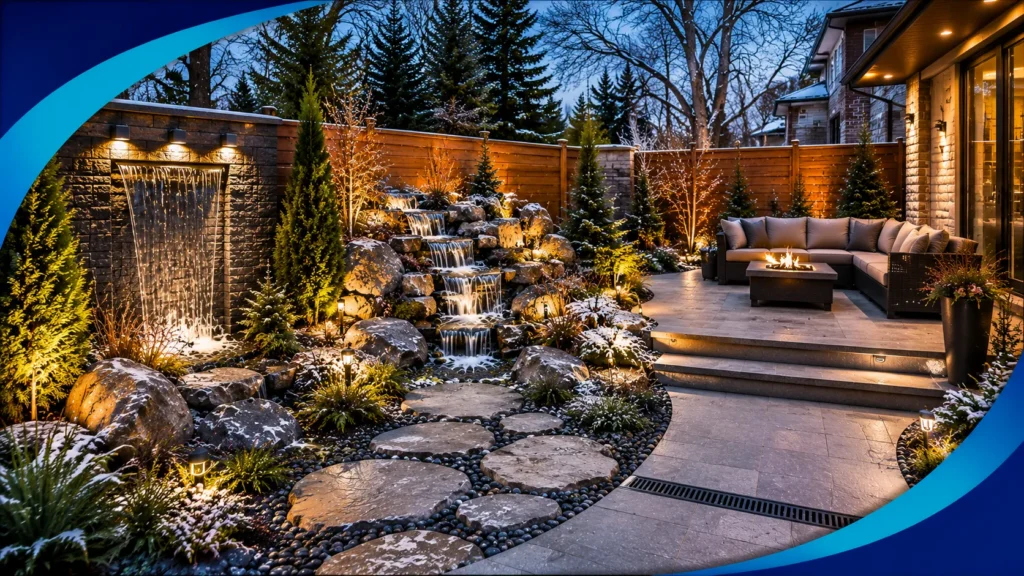
Toronto’s climate makes seasonal planning especially important.
Freezing temperatures can affect:
- Pumps
- Pipes
- Basins
- Exposed water
- Stone
- Plumbing connections
- Decorative materials
Outdoor fountain guidance commonly recommends draining and winterizing features in freezing climates to reduce the risk of weather-related damage.
The exact winterization process depends on the type of system.
A small decorative fountain may be drained and protected.
A pond may require a completely different winter strategy.
A custom waterfall may need its pump, plumbing and reservoir considered individually.
The important lesson is:
Don’t design a Toronto water feature as though it were going to operate in a climate with no winter.
Winter performance should be part of the design discussion before construction begins.
Should You Build a Water Feature Yourself or Hire a Professional?
A small decorative fountain can often be straightforward.
A custom waterfall, pond or stream is another matter.
Professional design becomes increasingly valuable when a project involves:
- Excavation
- Significant grading
- Large boulders
- Buried reservoirs
- Complex plumbing
- Drainage
- Permanent electrical work
- Landscape lighting
- Retaining structures
- Large ponds
- Difficult site access
- Integration with existing hardscape
A professional approach also helps address the hidden part of the project.
A beautiful waterfall isn’t successful if water escapes where it shouldn’t, drainage is inadequate, the pump is incorrectly sized or the surrounding landscape becomes difficult to maintain.
Common Backyard Water Feature Mistakes
Mistake 1: Choosing the feature before studying the yard
Start with the property, not Pinterest.
Your available space, slope, architecture and drainage should influence the design.
Mistake 2: Making the feature too large
A water feature should have the right scale for the landscape.
Mistake 3: Ignoring sound
A waterfall that sounds beautiful from five metres away may be too loud beside a dining area.
Mistake 4: Forgetting maintenance access
Pumps and equipment eventually need attention.
Make sure they can be reached without dismantling the landscape.
Mistake 5: Treating drainage as an afterthought
Water management is one of the most important technical considerations.
Mistake 6: Ignoring winter
Toronto water features need to be planned around freezing conditions.
Mistake 7: Making the feature look disconnected
A water feature should relate to the materials, plants and architecture around it.
Mistake 8: Using too many competing focal points
Your backyard needs hierarchy.
If the waterfall, fire pit, pergola, outdoor kitchen, lighting and planting are all competing for attention, the landscape can feel chaotic.
How to Integrate Water Features Into a Larger Backyard Design
A water feature becomes much more valuable when it is designed as part of the entire outdoor environment.
For example:
Waterfall + natural stone + planting + pathway + seating + lighting
Creates a complete destination.
Compare that with:
Waterfall sitting in the middle of a lawn
The second option may technically function, but it often feels disconnected.
Consider integrating your water feature with:
- Patios
- Custom Deck
- Pergolas
- Outdoor kitchens
- Privacy screens
- Planting
- Retaining walls
- Landscape lighting
- Walkways
This is also where a broader landscape design approach becomes important.
Everstruct’s existing Toronto backyard content emphasizes coordinating outdoor elements with architecture, circulation, materials, weather and long-term use rather than treating each feature as a standalone addition.
For homeowners planning a complete backyard transformation, explore Everstruct for a broader view of outdoor design and construction.
Using Landscape Lighting With Water Features
Water can become particularly striking after sunset because moving surfaces reflect light.
However, brighter isn’t necessarily better.
Instead of flooding the entire feature with light, consider highlighting:
- Falling water
- Stone edges
- Nearby planting
- Architectural walls
- Selected focal points
A carefully designed lighting system can make a waterfall visible from the house while keeping the overall backyard comfortable.
Everstruct’s Toronto backyard lighting guide also discusses integrating water features with landscape lighting, along with the importance of controlling glare and coordinating lighting with the broader landscape.
How to Make a Water Feature Look Natural
The secret isn’t simply adding more rocks.
Natural-looking water features depend on relationships between:
- Stone size
- Stone position
- Water movement
- Planting
- Surrounding grade
- Edge treatment
- Viewing angles
Avoid making every stone identical.
Natural landscapes have variation.
Some stones should feel structural.
Others should partially disappear into planting.
The water should also have a believable path.
A waterfall that looks like water has simply been poured over a pile of rocks rarely feels convincing.
How to Make a Modern Water Feature Look High-End
For contemporary homes, simplicity can be more effective than complexity.
Consider:
- Clean geometric lines
- Large-format stone
- Dark architectural materials
- Concealed plumbing
- Controlled water flow
- Integrated lighting
- Minimal planting
- Strong horizontal or vertical forms
A modern water wall can sometimes create more impact than a complicated artificial stream.
The design should support the architecture.
Are Backyard Water Features Worth It?
For the right homeowner, absolutely.
But the value isn’t simply in the water itself.
A well-designed feature can:
- Create a focal point
- Make an outdoor space feel more relaxing
- Improve the sensory experience
- Add visual movement
- Support a garden theme
- Make patios and seating areas more enjoyable
- Strengthen the overall landscape design
The feature is most successful when it solves a real design problem.
If your backyard feels flat and empty, a waterfall might provide structure.
If your patio feels visually hard, moving water can soften the space.
If your garden lacks a focal point, a fountain can provide one.
If you want wildlife and aquatic planting, a pond may be the better solution.
Frequently Asked Questions About Backyard Water Features
What is the easiest backyard water feature to maintain?
Small self-contained fountains and simple pondless features can be among the easier options to maintain. The exact maintenance depends on the design, equipment, water exposure and surrounding landscape.
What is the best water feature for a small backyard?
Compact fountains, bubbling rocks, wall fountains and small pondless waterfalls are often good choices because they can provide visual and auditory impact without consuming large amounts of space.
Are pondless waterfalls safer than ponds?
They can reduce the amount of exposed standing water, which can be useful for some households. However, they should not automatically be considered completely risk-free. The entire installation still needs appropriate safety planning.
Do backyard waterfalls attract mosquitoes?
Moving water generally behaves differently from stagnant water, but any water feature needs to be properly designed and maintained. Ponds and standing-water areas require particular attention to water circulation and maintenance.
Can a water feature work in a Toronto backyard?
Yes. Water features can be designed for Toronto properties, but the design should account for freezing temperatures, seasonal maintenance, drainage and the property’s specific conditions.
Can a water feature be installed on a slope?
Yes. A slope can actually create an excellent opportunity for a waterfall or stream because elevation can become part of the design.
How often does a backyard water feature need maintenance?
It depends on the type. A small fountain may need relatively simple periodic cleaning and water-level checks, while a pond with fish and plants requires more ongoing attention.
Can I add lighting to a waterfall?
Yes. Lighting can highlight moving water, stone and surrounding planting. Electrical components should be appropriately designed and installed.
Should a backyard water feature be near the patio?
Often, yes especially if sound and visibility are priorities. But the feature should be positioned so splash, humidity, maintenance and circulation do not create problems.
Does a pondless waterfall need a pond?
No. The water typically returns to a concealed reservoir rather than an exposed pond.
Can water features increase the value of a home?
A well-designed landscape can improve the appearance and enjoyment of a property, but homeowners should not assume that every water feature will return its full construction cost through resale value. Design quality, maintenance and buyer preferences all matter.
What should I ask a water-feature contractor?
Ask about:
- Design approach
- Drainage
- Winterization
- Pump selection
- Materials
- Maintenance
- Access to equipment
- Electrical requirements
- Warranty
- Project timeline
- Landscaping integration
- What happens if the system develops a leak
How do I choose between a pond and a pondless waterfall?
Choose a pond if you want aquatic life, plants and a larger water ecosystem.
Choose a pondless waterfall if your priority is movement and sound with less exposed water and a more compact footprint.
What makes a water feature look professionally designed?
Proportion, stone placement, water movement, planting, drainage, concealed infrastructure and integration with the surrounding landscape all contribute to a professional result.
The Best Backyard Water Feature Is the One That Fits Your Landscape
Backyard water features can be as simple as a small bubbling rock or as ambitious as a multi-level landscape waterfall surrounded by stone, planting and outdoor living areas.
The important question isn’t:
“Which water feature is the most beautiful?”
It’s:
“Which water feature makes sense for my property, lifestyle and landscape?”
For a compact Toronto yard, that might mean a wall fountain, bubbling rock or small pondless waterfall.
For a larger property, it could mean a natural rock cascade, stream, pond or koi garden.
For a modern home, an architectural water wall may be the strongest choice.
For an entertainment-focused backyard, a waterfall, pool feature or fire-and-water installation can become the centrepiece of the outdoor space.
Whatever direction you choose, plan the water feature together with the surrounding landscape. Consider grading, drainage, access, planting, hardscape, lighting, maintenance and Toronto’s seasonal conditions before construction begins.
A great water feature shouldn’t look like something placed in your backyard.
It should look like it was designed for your backyard.
If you’re planning a complete outdoor transformation in Toronto, explore Everstruct and consider how a professionally planned landscape can bring your water feature, hardscape, planting, lighting and outdoor living areas together into one cohesive design.